Hierarchy of Therapeutic Modalities
A guide to the layered structure of evidence-based therapeutic approaches, from foundational to advanced, and how they fit together.
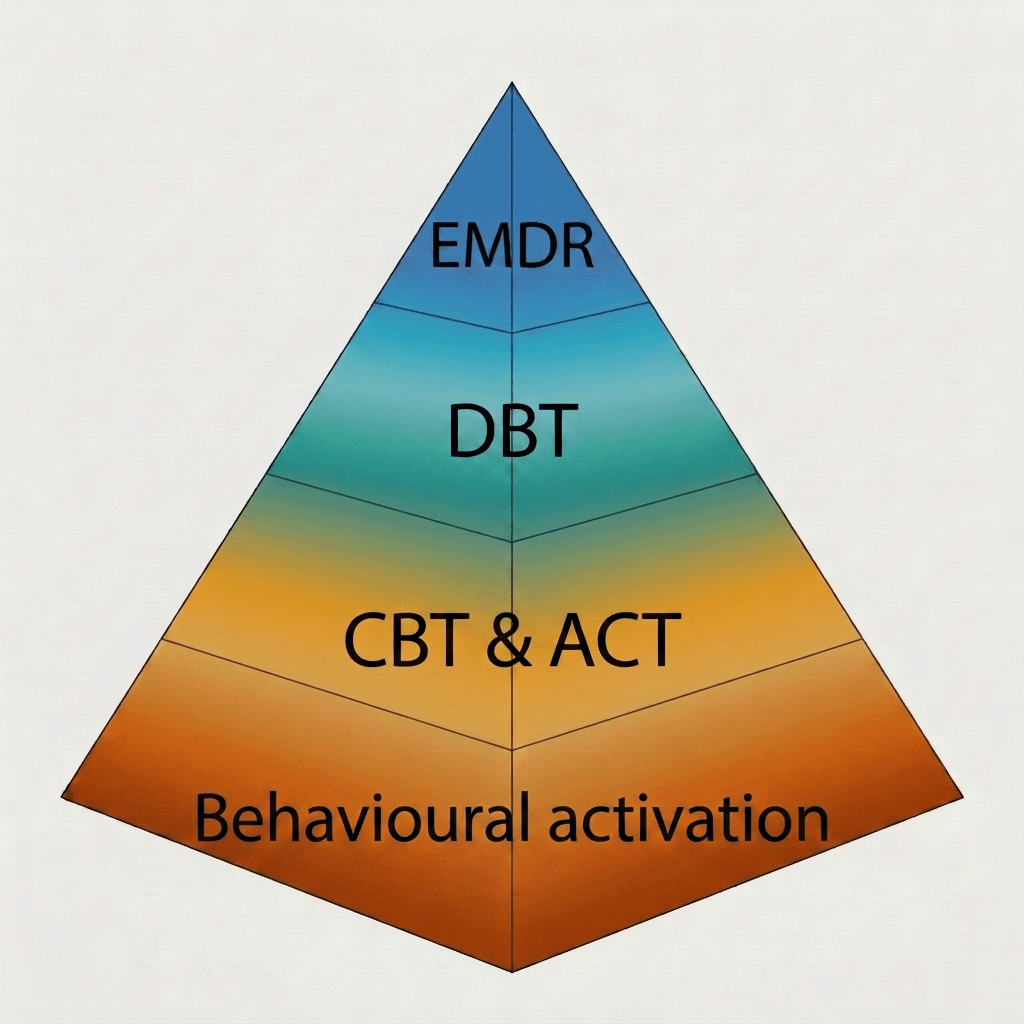
About This Hierarchy
Behavioural Activation is the foundational therapeutic approach that focuses on increasing engagement in meaningful, value-aligned activities to improve mood and motivation. Rather than waiting for motivation to arrive, we actively schedule and engage in activities that reinforce positive experiences and build momentum. This layer establishes routine, consistency, and the basic framework of psychological well-being, making it the essential ground upon which all higher-order therapeutic techniques are applied.
I remember the words of one young woman. She was recounting to me how angry her friend was that a psychologist had suggested she go for a walk. She was angry because it was so simple and so effective. As humans, we have a tendency to overcomplicate matters, but I tell everyone to start here.
Sleep, diet, exercise
Not getting enough sleep or eating a balanced nutritious diet? These are necessary to fuel your brain and body. Exercise, fresh air, and sunlight are also key. Is your routine disrupted? Are you searching for meaning and purpose in your life?
These are the foundation.
Always start here, and always return here. Behavioural activation strategies are the basics of maintaining good mental health day in day out. These are the strategies that make up self-care, self-help. Elegantly simple. Easily overlooked.
But knowing what to do and doing it are not the same thing.
For some, a gentle reminder is enough. For others, more support might be needed. Maybe you were doing fine, but now you’re struggling with an injury, or you’ve lost your exercise buddy, or your work schedule and gym hours don’t sync up, or it’s winter and you don’t feel safe going out after dark, or it’s summer and you’re avoiding the sun’s harmful rays, or you spend most of your day caring for someone else… you get the idea. Any number of things can get in the way when our routines get disrupted or we need to make a change.
Want more evidence? Start here: https://pmc.ncbi.nlm.nih.gov/articles/PMC11220350/
Want to try a free workbook? Start here: https://www.flinders.edu.au/content/dam/documents/engage/community/cbt/2-behavioural-activation.pdf
Sometimes we know what we need but not how to get past the obstacles. Sometimes we don’t know what we need to do or how to get started. Sometimes the obstacles are easier to see, and sometimes it takes a deeper dive with a therapist…
So, let’s talk about what’s getting in the way.
Cognitive Behavioural Therapy (CBT) is the standard therapeutic modality taught in all psychology programs. For therapists new and old, CBT provides a tried and true framework for helping people identify and challenge the thoughts that so often get in the way. The internet is full of free CBT worksheets that can be applied to any context. Whether undertaken as self-help or with the guidance of a therapist, CBT provides a structured approach to bring behavioural patterns, automatic thoughts, and underlying beliefs that perpetuate the problematic or maladaptive cycle we aim to change. For example, a treatment plan for depression might look like this:
| Session | Core Topic | Actionable Takeaway / Homework |
|---|---|---|
| 1: Setup | Assessment & Education | Log daily activities and baseline mood levels. |
| 2: Action | Behavioral Activation | Schedule 1-2 small, rewarding activities daily. |
| 3: Thoughts | Catching Automatic Thoughts | Identify thinking errors during mood drops. |
| 4: Challenge | Cognitive Restructuring | Complete a Thought Record to find balanced views. |
| 5: Deep Dive | Underlying Beliefs | Pinpoint core rules (e.g., “I must be perfect”). |
| 6: Future | Relapse Prevention | Write a blueprint for managing future triggers. |
While this is the skill-set of every new graduate psychologist, this is just the beginning. The fundamentals of CBT are solid, but some steps might need more creative approaches. Enter Acceptance and Commitment Therapy (ACT). Having trouble changing your thoughts? How about changing your relationship to your thoughts? For example:
I’m a loser
I’m having a thought that I’m a loser
I notice that I’m having a thought that I’m a loser.
ACT invites us to be a little more flexible, to change our relationship to our thoughts, allow ourselves to be present, and connect with our values. For example, the same six sessions could look like this:
| Session | Core Topic | Actionable Takeaway / Homework |
|---|---|---|
| 1: Hopelessness | Creative Hopelessness | Notice and list control strategies that do not work. |
| 2: Defusion | Defusion & Acceptance | Label thoughts as stories (e.g., “I’m having the thought that…”). |
| 3: Present | Contact with Present Moment | Practice 5-minute daily mindfulness grounding exercises. |
| 4: Self | Self-as-Context | Notice the distinction between your thoughts and yourself. |
| 5: Values | Values Clarification | Complete a values compass for meaningful life areas. |
| 6: Action | Committed Action | Set SMART goals based on values, despite low mood. |
Mindfulness can supplement any modality, and can be as simple as a breathing exercise on a smart watch through a deep focused period of attending to the activity at hand.
NEXT STEPS
Behavioural Activation, CBT, ACT, and Mindfulness are key foundational therapeutic frameworks that can provide meaningful change to a lot of people’s lives. They’re accessible, efficient, and adaptable for online and self-help options. But 40% of adult mental health presentations can be traced to childhood abuse and neglect, and those 40% need more. The deeper you go in learning all these different techniques, you may notice overlaps and similarities. Sometimes the same strategy is repackaged. The more you notice these similarities, the more you’ll build your flexible and eclectic style.
Dialectical Behaviour Therapy (DBT) is an elegant collection of skills-building that combines Mindfulness, Emotion Regulation, Interpersonal Effectiveness, Distress Tolerance, and Dialectical thinking training. DBT is a two-year program of individual and group therapy designed for people with Borderline Personality Disorder or Complex PTSD. Even if you are not working with that cohort or planning to do proper DBT, the training is worthwhile because the sub-skills can come in very handy for a lot of people. For example, DEAR MAN is a very helpful strategy to improve communication skills, and dialectics can be integrated into other conversations (eg: “I accept where I am, and I am moving forward.”)
Schema Therapy is another choice for working with more persistent challenges linked to attachment, maladaptive schemas, and coping styles. A schema is a framework, our general outlook on the world, formed on the basis of our early experiences. Once schemas are identified, a combination of experiential, cognitive, behavioural, and interpersonal strategies are used to shift the impact.
Narrative Therapy focuses on the story of your life. The language, culture, and the way in which you frame the story of your life is malleable and can be shifted. Like ACT, Narrative techniques aim to reduce the power of painful, fused thoughts and help people live lives guided by meaning rather than symptoms. Strategies include externalization, connecting with ancestors, and therapeutic certificates.
ADVANCED SKILLS
Eye Movement Desensitization and Reprocessing (EMDR) is a dynamic psychotherapy technique that aims to alleviate the emotional distress associated with traumatic memories. This evidence-based approach enables individuals to process and integrate traumatic experiences more effectively by utilizing bilateral stimulation, such as guided eye movements. Through the facilitation of these movements, EMDR helps clients reprocess disturbing memories, significantly reducing their emotional charge and impact. Often leading to rapid relief from symptoms of trauma, EMDR promotes a sense of safety and empowerment, enabling individuals to reshape their narratives and enhance their overall emotional well-being. As a versatile therapy, EMDR is applicable across various psychological conditions, making it a valuable option in trauma-informed care.
Polyvagal theory explores the role of the vagus nerve in emotional regulation, social connection, and fear response. It offers a biological framework for understanding how our nervous system influences our behavior and well-being. Somatic therapies, which focus on the connection between the mind and body, integrate these insights by using body awareness techniques to help individuals process trauma, reduce stress, and enhance emotional resilience. By addressing the physiological aspects of experiences, these therapies aim to create a sense of safety and promote healing from within, allowing individuals to reclaim their innate capacity for connection and regulation.
Adjunct creative therapies are complementary healing practices that enhance traditional therapeutic approaches by incorporating artistic expression and creativity. These therapies, which include art, music, dance, and drama therapy, allow individuals to explore their emotions, experiences, and identities in a non-verbal, expressive manner. By engaging in creative processes, participants can access deeper parts of themselves, facilitating healing and self-discovery. Adjunct creative therapies foster a sense of empowerment, improve emotional regulation, and encourage personal growth, making them valuable tools alongside conventional psychotherapy. This holistic approach nurtures the mind, body, and spirit, promoting overall well-being and resilience.
 Zen Warrior Princess